
What actually decides whether a roving transport system keeps up
A system can have the right number of trains and still fail to deliver on time. Efficiency here is a traffic problem, not a motor problem. These are the factors that decide it, and how we work around them.
Efficiency here does not mean what it usually means
When people call a machine efficient they normally mean it wastes little power or little material. For a transport system that is not the useful measure. A system can run all day, every day, and still fail at its job.
There is only one measure that matters. When a machine needs material, is the material already there?
Everything below is about that question.
Too few trains starve the floor. Too many block it.
The first thing that surprises people is that more trains is not safer.
With too few trains, frames wait. That is obvious and easy to spot, and it usually gets fixed.
With too many trains, something less obvious happens. Every train occupies track. Trains that are not needed right now still have to be somewhere, and wherever they are they are in the way of a train that is needed. Junctions back up. A train that should reach a ring frame in two minutes takes eight because it is queued behind three trains going somewhere else.
There is an upper limit to how many trains a given floor can hold before they start waiting for each other. It depends on the length of track, the number of stopping positions and how much parking there is. We work that limit out for every layout, and we size the number of trains from your own frames and production. If you want the arithmetic, we set it out in how many trains a mill actually needs. We would rather quote fewer trains with a better routing plan than sell you extra trains that make the floor slower.
Train length against machine size
A train carries a fixed number of bobbins. A speed frame doffs a fixed number. A ring frame creel takes a fixed number. When those numbers do not divide cleanly into each other, you get partial trains.
A partial train costs you in a way that is easy to miss. It takes the same track length, the same parking bay and the same junction time as a full one, and it carries less. A floor running many partial trains is doing more movement for the same output.
Where every frame is identical this is simple arithmetic. Where they are not, and in most real mills they are not, the right train length is the one that leaves the fewest partial trains across the whole floor. Working that out is part of the design, not something to settle on site.
Mixed spindle counts
Very few mills have a floor where every speed frame is the same size. Frames get added over the years, sometimes from different makers, sometimes second hand.
A system designed on the assumption that everything is uniform will look fine on paper and disappoint on the floor. The transport logic has to handle frames of different sizes feeding creels of different sizes, without the smallest frame setting the pace for everybody else.
Doff timing, and whether it clusters
Two mills can have the same number of speed frames and the same doff interval and still present completely different peak loads.
If the frames doff spread out across the hour, demand is smooth. If several doff within a few minutes of each other, you get a spike, and the system has to survive the spike rather than the average. Sizing on average demand is one of the more common ways to end up with a floor that works most of the time and lets you down at the worst moment.
How often you change counts and mappings
A mill that runs one count and never changes which frame feeds which can use a simpler system, and should.
A mill that changes counts regularly, or shifts production between frames, is asking the transport system to do something quite different. That is the real dividing line between fixed-flow and flexi-flow, and it is worth being honest about at design stage rather than a year after commissioning.
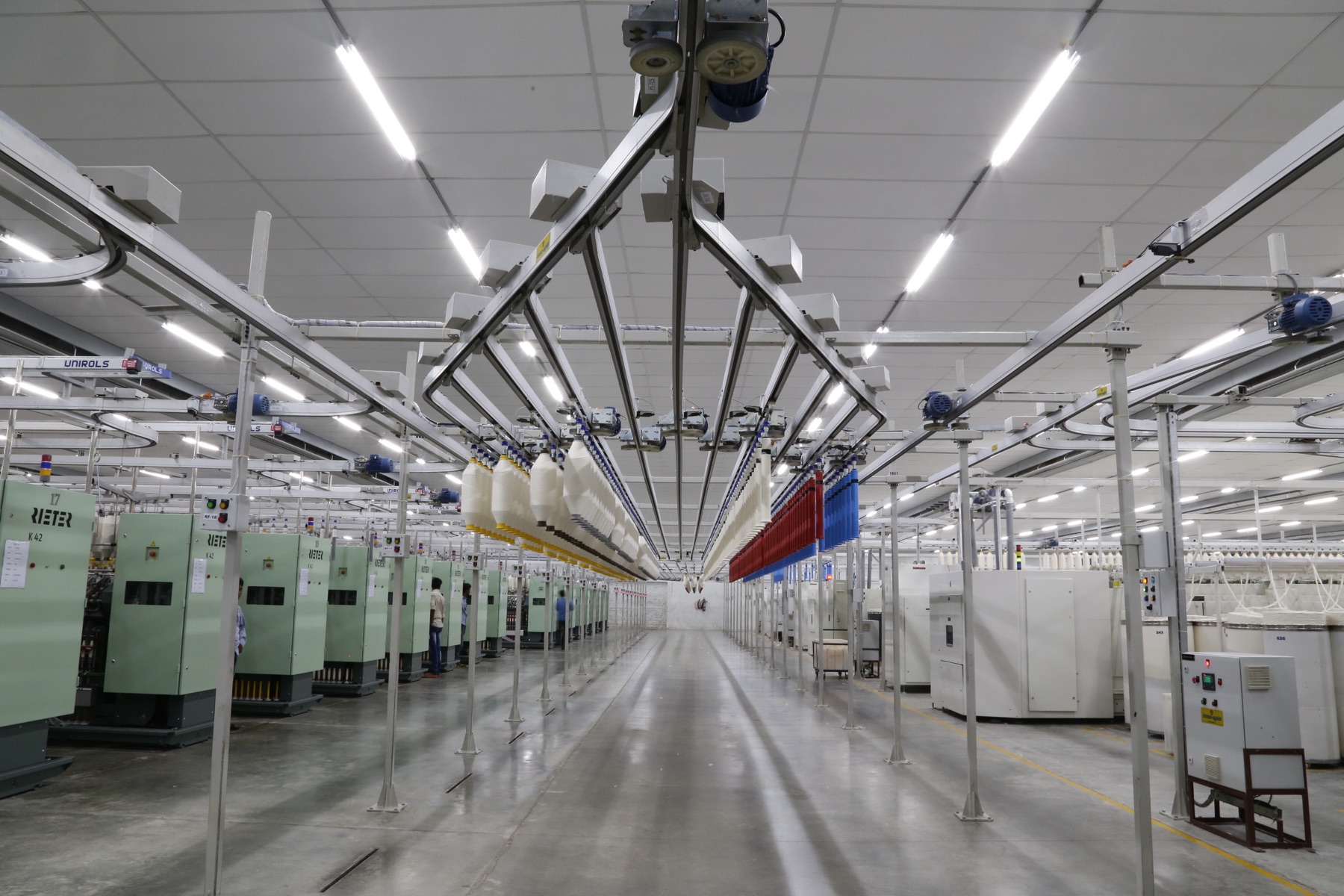
Parking, and whether it is usable parking
Parking capacity is not just a bay count. What matters is how many of those bays will accept the train that needs one right now.
If a bay belongs to a particular speed frame or a particular ring frame, then a free bay is often the wrong bay. You can have empty parking and a waiting train at the same moment. We have written about this separately, but it belongs on this list because it is one of the largest single influences on whether a floor flows.
The empty bobbin return path
This one is missing from almost every specification we are asked to comment on.
Full bobbins going out is only half the job. Empty bobbins have to come back, get stripped, and be ready in the right place at the right time. If the return path is an afterthought, empties pile up where they are not wanted and the frames that need them wait. On auto-doffing frames that is not an inconvenience, it is a stoppage.
What we do about it
The detailed routing logic sits with our engineers. What we can describe is the shape of the approach.
- We work out the train length that leaves the fewest partial trains across your actual machine list, not a typical one.
- We calculate the number of trains that gives good delivery without congesting your track, and we tell you both the recommended number and the ceiling.
- Our separate buffer parking is dynamic, so a free bay is a usable bay.
- Destinations are decided while the system is running, based on what is actually needed at that moment, rather than being fixed when the system is installed.
- We size against clustered doffing, not average demand.
If you want this applied to your own floor, our configuration portal takes your speed frame and ring frame details and shows you the working.
Run the inno-spin RTS Configuration Portal
Our free portal takes your Speed Frame and Ring Frame parameters and gives you a Fixed-flow vs. Flexi-flow recommendation backed by your own production data.
Configure my RTS →