
Bobbin transport is not an accessory item
On most quotations the roving transport system sits as one line among many. But of all the automation on a spinning floor, it is the one piece that sits inside the material path. That changes how it should be bought.
The line item nobody reads twice
When a mill plans a new unit or a modernisation, the quotation that arrives is usually a long one. Overhead travelling cleaners, yarn conditioning, cone transport, packing, and somewhere in that list, roving transport. Each gets a line and a price. The eye goes to the total.
We understand why this happens. A mill owner is buying a plant, not a shopping list of parts. Anyone who can supply more of that plant from one place is making life simpler, and that is a genuine benefit.
We are not arguing against that. Inno-spin is itself moving towards supplying more of the line, and we think that is the right thing to do. What we want to explain is something narrower: why roving transport, whatever else it is bundled with, deserves to be looked at on its own terms.
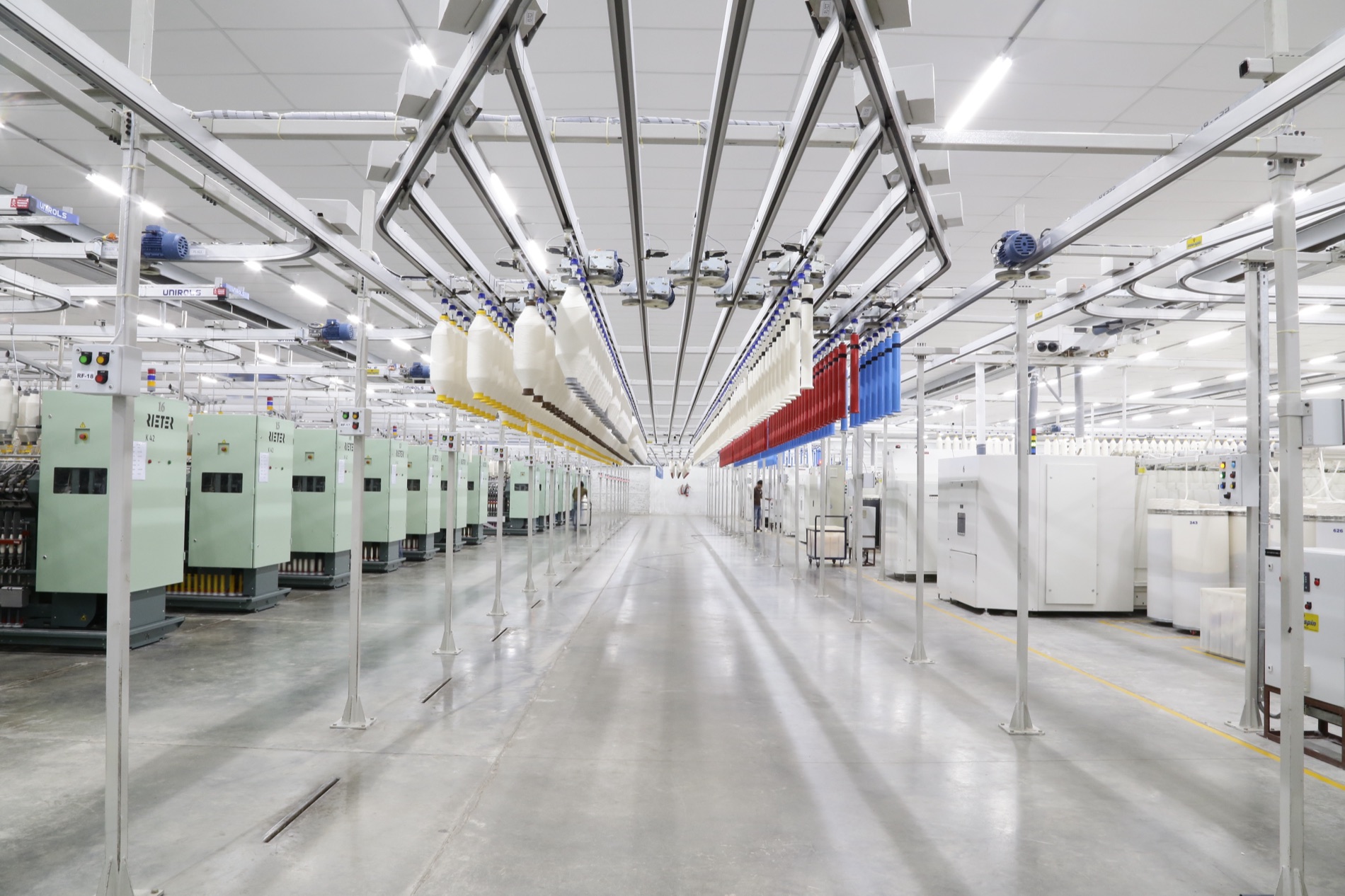
Position in the flow decides the cost of failure
Start with a simple question. If a piece of equipment stops for one hour, what happens to production?
An overhead cleaner stops, and the floor gets dustier until it runs again. A yarn conditioning plant stops, and conditioning gets rescheduled. Cone packing stops, and cones accumulate at winding for a while. None of these are pleasant. The mill keeps spinning through all of them.
A roving transport system stops and two departments stop with it. The speed frame has nowhere to send full bobbins, so it fills up and shuts. The ring frame creel keeps depleting with nothing coming in. You are not losing convenience. You are losing spindle hours at both ends of the floor at the same time.
| If this stops for an hour | What actually happens |
|---|---|
| Overhead cleaner | Cleaning falls behind. Spinning continues. |
| Yarn conditioning | Conditioning is rescheduled. Spinning continues. |
| Cone packing | Cones build up at winding. Spinning continues. |
| Roving transport | Speed frames block and ring frames starve. Spinning stops. |
This is not a claim about which supplier is better than another. It is a statement about where the equipment sits in the line.
It is built for your floor, not selected from a catalogue
Most mill equipment is chosen by capacity. You state the throughput you need and the supplier tells you which model covers it. The machine that arrives at your gate is the same machine that arrived at somebody else's.
A roving transport system does not work like that. There is no model number that fits a mill. What gets designed depends on:
- where your columns and beams are
- how much clear height you have above the speed frames
- the aisle widths you can spare
- how many speed frames you have, and whether they all have the same spindle count
- how long each doff takes, and whether the frames doff together or spread out
- how often you change counts, and how often you re-map which frame feeds which
- how much space you can give to parking, and where it can go
Change any one of these and the design changes. Two mills with identical machinery lists can need quite different transport systems because one of them has a column line in an awkward place.
That is why we ask for a layout before we quote a price. It is not a delaying tactic. Without the layout there is nothing real to quote.
Who answers the phone when it stops
An overhead cleaner is a self-contained unit. If one is down the others carry on. A transport system is one connected thing spanning the whole floor, and a fault in one section can hold up everything downstream of it.
So the useful question is not only who supplies it. It is who comes and fixes it, how quickly they get there, and whether that person has spent years on transport systems or was commissioning a packing line last week.
Where bundling fits
None of this is an argument against buying a bundle. Bundles are convenient, they cut down the number of people you deal with, and when one supplier owns the joins between systems those joins tend to work better. We are building our own bundle for exactly those reasons.
The argument is only this: when transport sits inside a bundle, make sure it is still being engineered and not merely included.
Three questions do most of the work.
- Ask for it as its own line. Its own capital cost, its own spares list, its own service terms. If the price only exists inside a total, there is nothing to compare.
- Ask who did the layout engineering, and ask to see it. A transport design should show your columns, your aisles, your frames and your parking. Not a standard drawing with your name on it.
- Ask who services it. Where they are based, what they have worked on, and how fast they can be on your floor.
If the answers are good, buy the bundle with confidence. If the transport line turns out to be a number somebody added at the end, that is worth knowing before the order rather than eighteen months after commissioning.
What we are
We build roving transport systems. It has been our main product for a long time, and for most of that time it was the only thing we did. We now supply more of the line than we used to, because customers asked us to and because owning the joins between systems is better for them.
The transport system is still the thing we know best, and it is still what we would rather be judged on. If you are evaluating one, from us or from anybody else, send us your layout and we will tell you what we think. That includes the times when the honest answer is that a simpler system will do the job.
Run the inno-spin RTS Configuration Portal
Our free portal takes your Speed Frame and Ring Frame parameters and gives you a Fixed-flow vs. Flexi-flow recommendation backed by your own production data.
Configure my RTS →