
Auto-doffing speed frames: does fixed-flow still work?
If your speed frames doff automatically, the transport system has to return a full set of empty bobbins inside the doff window, every single time. Here is the arithmetic, and what to watch for if you still want the simpler system.
The requirement an auto-doffer creates
A manual doff is forgiving. If empty bobbins are slow to arrive, an operator waits a little or fetches them, and the frame carries on.
An auto-doffing frame is not forgiving. It runs a fixed sequence. It needs a full set of empty bobbins presented to it, and it needs them within the time the frame takes to build the next doff. Miss that window and the frame does not slow down gracefully. It blocks, and it stays blocked until the exchange is finished.
So the question for an auto-doffing frame is narrow and it has a definite answer. Can the transport system complete the exchange inside the doff window, reliably, every time?
The arithmetic
Take a common case. A 240 spindle speed frame, roughly two hours to build a doff.
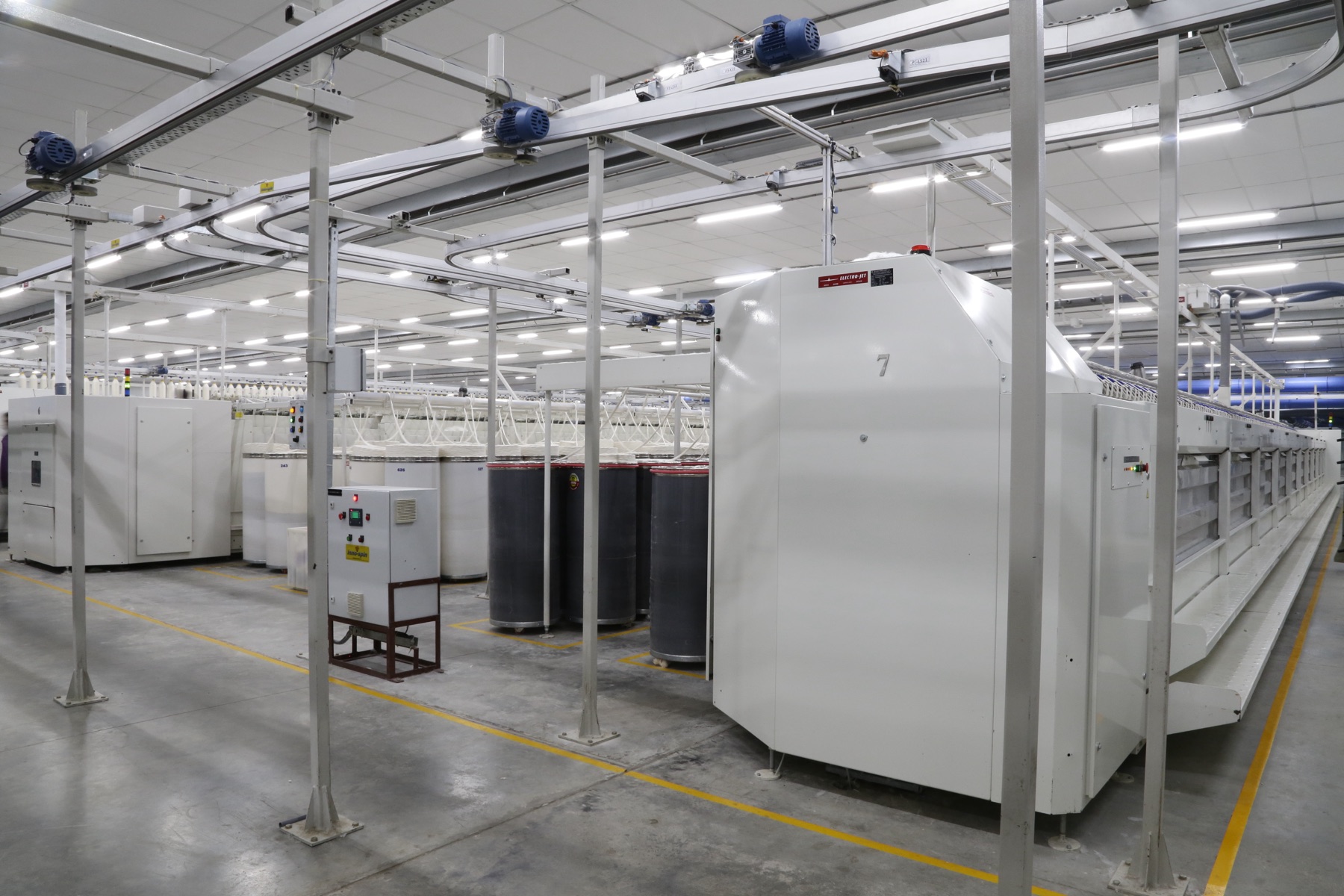
On flexi-flow, a complete train of empty bobbins is already parked at the frame before the doff finishes. The exchanger works straight through at 180 bobbins an hour. 240 divided by 180 is one hour twenty minutes. The window is two hours, so you finish with forty minutes in hand.
On fixed-flow, the exchanger works off the moving loop. Our stated minimum there is 120 bobbins an hour. 240 divided by 120 is two hours exactly. The exchange fills the whole doff window with nothing left over.
And that is the best case, not the expected case.
Why the fixed-flow figure is a best case
The exchanger swaps two positions at a time, so it needs two empty bobbins next to each other.
On a closed loop, what arrives is whatever happens to be on the loop: full bobbins, bare holders and single empties, in no particular order. When the exchanger cannot find a pair it waits for the loop to bring one round. Every skip costs seconds, and those seconds add up across 240 positions.
To hold the best-case rate, somebody has to keep loading empty bobbins onto the loop in pairs, continuously, for the whole exchange. In a mill where that same operator is piecing ends and cleaning, it does not happen consistently. That is not a criticism of anyone. It is simply not a realistic thing to ask of a person for two hours at a stretch.
When the rate slips, the exchange runs past the doff window, the previous doff is not cleared in time, and the frame stops.
What we recommend
For auto-doffing speed frames, flexi-flow is the arrangement we recommend and the one we can stand behind without conditions. The pre-parked train removes the searching completely, and that is where the entire margin comes from.
This matters more the further you are from the example above. Longer frames need more bobbins inside the same window. Coarser hanks shorten the window. Both push you the same way.
Our Twin Bobbin Exchanger cum Stripper runs at 180 bobbins per hour on flexi-flow. For lower counts and larger speed frames, we also offer our latest high-speed version, which reaches up to 300 bobbins per hour with the stripper built in.
If you still want fixed-flow
Sometimes the budget decides, or you want to start smaller and see how it goes. That is a legitimate choice and we will supply it. Go in with your eyes open on these points.
- Do your own arithmetic first. Take your spindle count, divide by 120, and compare that honestly against your real doff interval. If the answer lands anywhere near your window, it will not hold in practice.
- Shorter frames and finer hanks give you room. A smaller spindle count against the same window leaves margin, and that margin is what absorbs the skipping.
- The operator dependency is real. The system reaches its stated rate only if empties keep arriving in pairs. Decide who is responsible for that, on every shift, before you commission and not afterwards.
- Watch the return path. Fixed-flow has no parking, so empty bobbins live on the running loop. Keeping the right number of empties circulating becomes an ongoing operational job.
- Settle the layout question now. If there is any chance you will want to move to flexi-flow later, tell us at design stage. Some layout decisions are cheap to make now and expensive to undo once the steelwork is up.
- Consider starting with one loop. Several mills have put fixed-flow on a single section first, to watch how it behaves on their own floor before committing further. It is a sensible way to find out.
Where fixed-flow is genuinely the right answer
We should say this plainly, because the article so far reads one way.
For manually doffed speed frames, in a mill running a simple count mix without frequent re-mapping, fixed-flow is often the sensible choice. There is less to maintain, it is simpler to operate and it costs less. Pushing flexi-flow at a mill that does not need it would not be good engineering.
The distinction is not that fixed-flow is bad and flexi-flow is good. It is that auto-doffing puts a hard deadline on the transport system, and fixed-flow meets that deadline only under conditions that are difficult to hold in a working mill.
If you want the numbers for your own frames, our configuration portal will run the arithmetic from your spindle counts and doff intervals and show you the working.
Run the inno-spin RTS Configuration Portal
Our free portal takes your Speed Frame and Ring Frame parameters and gives you a Fixed-flow vs. Flexi-flow recommendation backed by your own production data.
Configure my RTS →